
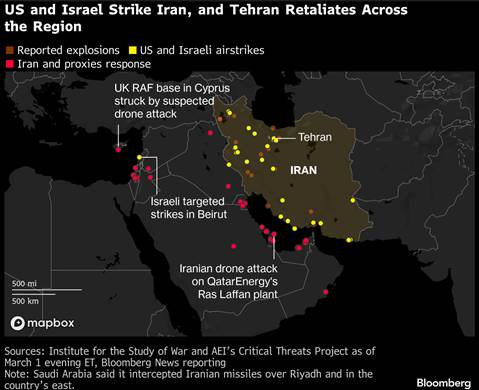
Many awoke to news last Saturday morning of the U.S. and Israel jointly launching airstrikes against Iran’s military capabilities and leadership structure. The buildup to what has been deemed, “Operation Epic Fury”, has been ongoing with U.S. military assets moving in the Middle East over the last few weeks. While negotiations over Iran’s nuclear capabilities and ambitions were still ongoing, it was ultimately determined that these would fail to meet demands by the U.S., leading to the joint air assault.
At this time, the situation remains very fluid, which is typical with any military event of this nature and scope. The quote/proverb, “The first casualty of war is the truth”, is a sobering reminder that much still remains unknown at this time.
There will be many questions in the coming days regarding the geopolitical implications; internal debate in the U.S. over the actions; and further unexpected surprises as events unfold. As initially outlined by President Trump, the four goals of this operation were to stop Iran from building a nuclear bomb, destroy Iranian missiles, “annihilate” the Iranian Navy (making it more difficult for Iran to attack U.S. interests from sea), and provide the Iranian population the opportunity to “retake” their government, though U.S. Defense Secretary Hegseth has explicitly stated, “that this is not a so-called regime-change war.”
As we write, reports include the death of Iranian Supreme Leader, Ayatollah Ali Khamenei, in addition to several key members of Iranian leadership, retaliatory strikes against several Gulf states, affecting both U.S. military and civilian infrastructure, and at least six deaths of U.S. military personnel. The campaign is expected to last for 4-5 weeks, according to President Trump. He has also recently noted he will not rule out ground troops, raising the stakes to the U.S.
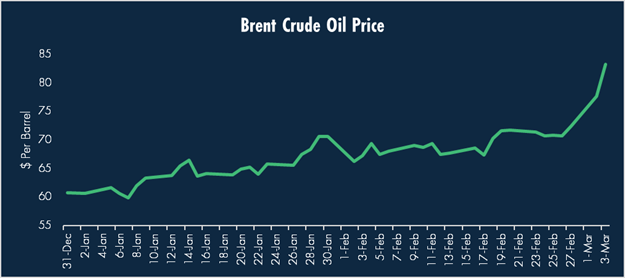
It goes without saying that the loss of human life is tragic; however, as we’ve written before, from a market perspective, a disruption to the supply or transportation of oil remains the key risk, as an estimated 15-20% of global oil supply flows through the Strait of Hormuz, a key choke-point controlled by Iran. While at this time, Iranian forces have not formally closed the strait, there has been a significant decline in traffic due to the elevated risks of passage and removal of insurance coverage for carriers. Additionally, reports continue that disruptions are mounting to other energy facilities in Iraq, Saudi Arabia, and the UAE. Oil prices spiked sharply over the weekend and continue to remain elevated, with Brent Crude sitting around $83 per barrel as we write.
U.S. stocks initially took events in stride but, as of the morning of March 3rd, downside volatility has been more prominent as markets assess the potential for a longer than expected disruption to energy markets and subsequent impact on inflation. The U.S. dollar is demonstrating the power of being the reserve currency, up almost 2% since Friday. Gold initially showed similar defensive characteristics, gaining on Monday, but has fallen by more than 5% in early trading on Tuesday. Perhaps somewhat counterintuitively (given the stronger dollar), bond prices were lower as yields rose on elevated inflation fears, driven by higher oil prices. The potential for an inflation shock has removed expectations for a third rate cut this year, with markets not pricing in a rate cut until September.
As with any major geopolitical event, investors seek certainty when uncertainty is suddenly thrust upon their near-term investment horizon. Markets typically have knee-jerk reactions to uncertainty, as it seeks to assess the implications to economic growth, corporate earnings and valuations. It seems overly simplistic to state that, “we have been here before”, in the wake of the recent events of October 7th, 2023, in Israel and the 12-day war in 2025 between Israel and Iran. Unfortunately, the Middle East is no stranger to conflict, but the scale of the attack, the element of surprise, and the elimination of a sovereign leader by the U.S., does potentially raise the stakes and likely means continued volatility in the near-term.
We are in the early innings of this event and the longer this plays out, the greater the chance of a prolonged spike in oil, a central risk hanging over the market given its importance to the global economy. Historically, we have witnessed markets move past the “shock and awe” of previous military events in short order, though each period brings a heightened degree of uncertainty and risk that “this time is different.” We do not profess any crystal ball as to how this will play out, but we do know that staying disciplined remains key to investor success. As always, we stay focused on the long game.
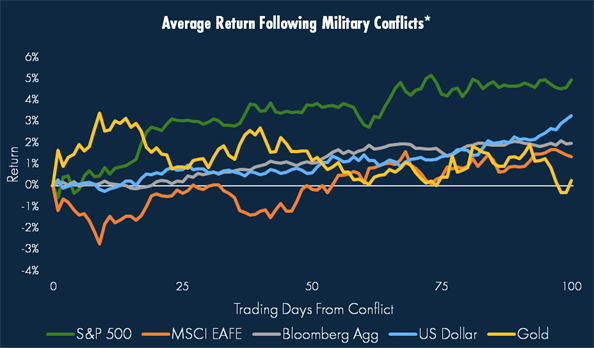
*Return data used as available. Conflicts included are: Israel Iran War (2025), Hamas Attack on Israel (2023), Russia Invasion of Ukraine (2022), Crimea Conflict (2014), U.S. Invasion of Iraq (2003), September 11 Attacks (2001), Kosovo War (1999), Iraq Invasion of Kuwait (1990), Iran-Iraq War (1980), Arab Oil Embargo (1973), Cuban Missile Crisis (1962), Pearl Harbor Attack (1941), and the German Invasion of Poland (1939).
© 2026 Advisory services offered by Moneta Group Investment Advisors, LLC, (“MGIA”) an investment adviser registered with the Securities and Exchange Commission (“SEC”). MGIA is a wholly owned subsidiary of Moneta Group, LLC. Registration as an investment adviser does not imply a certain level of skill or training. The information contained herein is for informational purposes only, is not intended to be comprehensive or exclusive, and is based on materials deemed reliable, but the accuracy of which has not been verified.
Trademarks and copyrights of materials referenced herein are the property of their respective owners. Index returns reflect total return, assuming reinvestment of dividends and interest. The returns do not reflect the effect of taxes and/or fees that an investor would incur. Examples contained herein are for illustrative purposes only based on generic assumptions. Given the dynamic nature of the subject matter and the environment in which this communication was written, the information contained herein is subject to change. This is not an offer to sell or buy securities, nor does it represent any specific recommendation. You should consult with an appropriately credentialed professional before making any financial, investment, tax or legal decision. An index is an unmanaged portfolio of specified securities and does not reflect any initial or ongoing expenses nor can it be invested in directly. Past performance is not indicative of future returns. All investments are subject to a risk of loss. Diversification and strategic asset allocation do not assure profit or protect against loss in declining markets. These materials do not take into consideration your personal circumstances, financial or otherwise.
Related Topics to Explore

Third Quarter 2026 Investment Update
October 20, 2026
Executive Summary The third quarter of 2026 reinforced a market environment in which economic resilience and corporate e…


Monthly Recap – August 2026
September 10, 2026
August Observations Markets Recover from a Summer Lull After two weaker months, US equity markets were in a risk-on mood…

The Bond Market Speaks: Unraveling the Recent Increase in Interest Rates
September 2, 2026
There is no excerpt because this is a protected post.