

Quarterly Letter
“I am an optimist. It does not seem too much use to be anything else.” – Winston Churchill
Faced with oil at one hundred dollars per barrel, wars in the Middle East and Ukraine, rising interest rates and a ten percent chance, at least according to one prognosticator, of humanity being wiped out by Artificial Intelligence (AI), investors refused to let pessimism ruin the quarter. It has, indeed, been quite a 2026. We had a first quarter that was defined by the war in Iran. It was all AI in the second quarter. For the third quarter, inflation and higher interest rates took precedence. Despite it all, investors stayed resilient, confronting one worrisome headline after another.
Why the resiliency? Perhaps an old stock market adage explains it best: The stock market acts like a barometer, not a thermometer. Its moves are based on the outlook for business and economic conditions in the future, as opposed to current conditions. That future, at least to many, seems promising, especially for any company with an AI connection. These companies are experiencing earnings that are not just good; they are off the charts. The average third quarter earnings gain among the largest companies in the United States, year over year, was over twenty-five percent. Perhaps even more startling, FactSet tells us this is the third quarter in a row of such results. As a result, the valuation of the U.S. stock market, relative to earnings, is lower today than a year ago, despite the remarkable appreciation in stock portfolios over the past year. It is a rare and beautiful thing when earnings growth outpaces stock price gains in a bull market.
Nonetheless, this is a market that is all about the winners and losers of the AI revolution, as evidenced by the fact that market breadth – the number of stocks going down versus up – is worrisome. Although the S&P 500 Index of large U.S. companies ended September within one percent of its all-time highs reached in August, an equal weighting of the companies in that index, rather than one based on market size (where the large technology companies dominate), dropped five percent in September alone. Even more unusual, more S&P 500 company stocks made their fifty-two-week lows, than highs, in September. Bears are suggesting that such weak market breadth implies more downside for stocks in coming months. Optimists counter that market breadth has been so bad that it suggests a strong recovery for the lagging stocks.
Speaking of the AI winners, of particular note in the third quarter was new mainstream awareness for what are known as Persistent Agents. Muse, from Facebook parent Meta, received the most attention. Persistent Agents keep working on your computer devices even after you have logged off. The concept is for your devices to become, in effect, super-assistants. Once you input data related to your personal needs, such as your daily calendar, selected account logins, emails, bank, insurance and bill-paying information, your Persistent Agent takes over. It uses what it has learned from your inputs to browse websites that would be of interest to you. It then places orders, fills in forms, summarizes messages, provides advice on how to improve your money management, offers travel ideas, and keeps you up to date and on track – all without any prompting by you. It is an astounding advance, although not without some obvious and somewhat scary risks.
While we are on the subject of potential risks, after three years of positive stock market gains, it would be easy to peer into a crystal ball and suggest that it is time for a decent stock market correction. The stock market has always been two steps forward and one step back. Higher interest rates – the highest in about twenty-five years – are an additional headwind. Without some type of resolution to the war in Iran, those interest rates might stay at levels that hurt businesses that need to borrow, and particularly impact home buyers seeking mortgages they can afford. There is also the November election on the horizon, a real wild card given that many voters seem frustrated with both major party choices. In other words, lots of “stuff” to worry about. Despite that, we constantly remind ourselves that much more money has been lost in preparation for a correction than in an actual correction itself. It is not time to hunker down just yet.
As we see things, U.S. labor markets are tight, but still good. We have low unemployment, and the job losses many fear from AI are not yet showing up. Corporate earnings are projected to be solid for the next several quarters, and one could argue they might even improve if the situation in Iran or Ukraine gets better. Progress in Iran or Ukraine would likely cause a drop in interest rates and set the stage for more encouraging inflation news. Thus, our best guess is that the markets will continue to power past current challenges. Unexpected market volatility can pop up at any time, but the overall outlook remains positive.

Market Commentary
Stocks reached record highs in August before slipping in September, as longer-term interest rates climbed to their highest levels since 2002. Most major asset classes remain higher for the year, led by commodities.
- U.S. Large Cap stocks, as measured by the S&P 500, gained about 2% in the third quarter and are now up 13% year-to-date. Strong corporate earnings helped large companies hold up even as borrowing costs surged. U.S. Small Cap stocks, as measured by the Russell 2000, gave back some of their strong first-half gains, falling about 7% during the quarter. Nonetheless, they remain up 14% for the year.
- International stocks were little changed. Developed Markets rose about 1% during the quarter and are up 10% for the year. Emerging Markets were basically flat for the quarter but are still up 23% year-to-date.
- Bonds fell about 3.5% during the quarter and are down 3% for the year. Interest rates rose sharply in September. When rates rise, the prices of existing bonds fall.
- Commodities jumped 16% during the quarter and are up 33% year-to-date, driven by oil. Renewed fighting in the Middle East has kept global oil prices near $100 a barrel. However, it was a mixed bag. Natural gas prices fell, agricultural commodities were flat, and gold was up for the quarter but fell more than 6% in September.
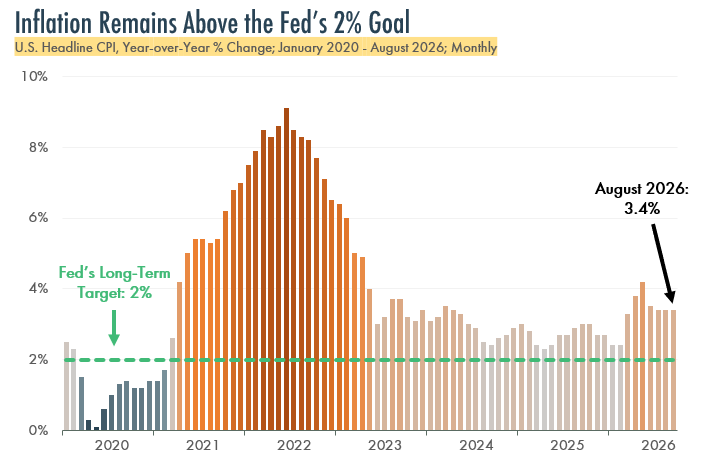
In September, the Federal Reserve raised short-term interest rates for the first time in three years, to a range of 3.75% to 4.00%. The move aims to bring down inflation, which has stayed above the Fed’s 2% target for more than five years.
AI Is Reshaping the U.S. Economy
While rising interest rates grabbed headlines, artificial intelligence (AI) remains a big driver of the U.S. economy, from data centers to the everyday “assistants”, as shown in the bottom left. By some estimates, it accounts for nearly half of recent economic growth.
As shown to the right, AI spending is on track to be the largest infrastructure build-out in U.S. history relative to the size of the economy. Past build-outs like the railroads and the internet eventually delivered lasting benefits, but all went through painful busts along the way.
Many of the leading AI companies are intertwined, making deals to invest in, buy from, and sell to one another, as shown in the bottom right. These ties can undoubtedly speed up growth. However, if demand for AI falls short, the concern is that trouble at one company could spread to the others.
Higher Rates Weigh on Borrowers, Reward Savers
Treasury yields are higher at every maturity than at the end of last year and well above where they were five years ago, as shown to the right. The 10-year Treasury yield ended September at 5.29%, near its highest level since 2002.
Higher energy prices, expected Fed rate hikes, and heavy borrowing by the government and by companies funding AI are all pushing interest rates up. For bond investors, the silver lining is that longer-term Treasury bonds now pay their highest yields in more than two decades.
The cost of borrowing is weighing on housing, with mortgage rates above 7% in late September. As shown in the bottom left, spending on homes and other private construction has fallen, while data center spending has kept climbing.
Rising rates have also made the U.S. federal debt more expensive to carry. As shown in the bottom right, U.S. federal debt passed $40 trillion in August, or more than $117,000 per person. The government now spends more on interest than on national defense. It is an unsustainable path.
The State of the U.S. Consumer
While government debt keeps climbing, most U.S. households remain on solid footing. Consumers have kept spending despite higher prices but seem to be spending prudently. The job market has cooled but is holding steady, and unemployment is still historically low.
A rising stock market has dramatically lifted household wealth. As shown to the right, U.S. household net worth has more than tripled since 2009. That added wealth has helped support spending.
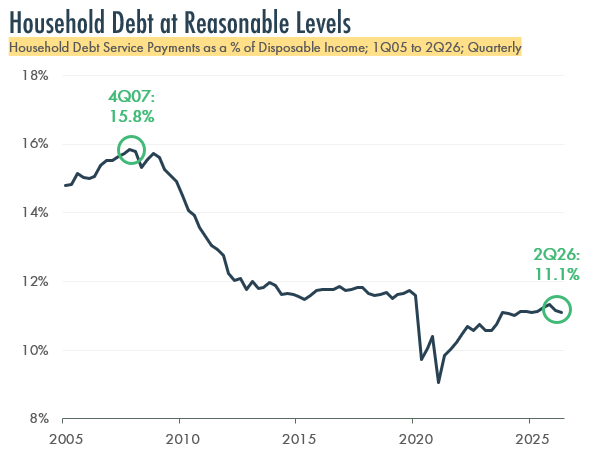
At the same time, debt payments take up a significantly smaller share of households’ after-tax income than they did before the 2008 financial crisis, as shown below. Many homeowners locked in low mortgage rates years ago, which has helped keep payments manageable even as rates have risen.
Prices are the main pressure point. As shown in the bottom right, inflation has cooled from its 2022 peak, but it is still above the Fed’s 2% goal. The months ahead will test how long consumers will keep spending in the face of higher prices.
Contributors

@ 2026 The Finerty Team
The S&P 500 Index is a free-float capitalization-weighted index of the prices of approximately 500 large-cap common stocks actively traded in the United States. The Bloomberg US Aggregate Bond Index is a broad base, market capitalization-weighted bond market index representing intermediate term investment grade bonds traded in the United States. The Consumer Price Index (CPI) is a measure of the average change over time in the prices paid by urban consumers for a market basket of consumer goods and services. Note #1: Performance returns cited represent past performance, which is not indicative of future returns. Note #2: Index and/or Style returns reflect total return, assuming reinvestment of dividends and interest. The returns do not reflect the effect of taxes and/or fees that an investor would incur. Investors cannot invest directly in an index. Opinions expressed herein are solely those of the Finerty Team as of the date of this commentary and subject to change without notice. These materials were prepared for informational purposes only based on materials deemed reliable, but the accuracy of which has not been verified. Trademarks and copyrights of materials referenced herein are the property of their respective owners. This is not an offer to sell or buy securities, nor does it represent any specific recommendation. You should consult with an appropriately credentialed professional before making any financial, investment, tax or legal decision. All investments are subject to a risk of loss. Diversification and strategic asset allocation do not assure profit or protect against loss in declining markets. These materials do not take into consideration your personal circumstances, financial or otherwise.
© 2026 Steven L. Finerty, J.D., CFP®, Logan W. Finerty, CFA, CFP®, Jeffrey T. Wist, J.D., CFP®, Susan E. Brown, CFP®, Timothy C. Burford, CFA, Jerrod C. Anderson, CFA, CFP®. Advisory services offered by Moneta Group Investment Advisors, LLC, (“MGIA”) an investment adviser registered with the Securities and Exchange Commission (“SEC”). MGIA is a wholly owned subsidiary of Moneta Group, LLC. Registration as an investment adviser does not imply a certain level of skill or training.