


A Coordinated Approach to Personal, Business, and Estate Planning for Business Owners
For many business owners, the business is far more than an income source. It is often the largest asset on the balance sheet, the engine behind personal wealth, and a central part of the legacy they hope to leave behind.
Yet the decisions that shape the future of that business are often made in separate conversations. Personal financial planning may happen in one place. Business planning happens somewhere else. Estate planning is handled separately by legal and tax advisors. Each professional may do excellent work within his or her discipline, but when those conversations are not coordinated, important gaps can emerge.
At Moneta, we refer to these as the Three Planning Arenas™: personal planning, business planning, and estate planning. For business owners, these arenas are deeply connected. A decision made in one can significantly affect the others.
That matters because someday you may no longer be at the helm of your business, whether by choice, circumstance, or an event you did not see coming. If that day arrived sooner than expected, would your current planning protect your family, your wealth, your business, and your legacy?
It is impossible to predict every future outcome. Illness, disability, market changes, partner disputes, family transitions, and unexpected opportunities can all reshape the timeline. But owners who begin planning early and coordinate decisions across all three arenas typically have more flexibility, more choices, and greater control than those who delay.
Early planning is important. Coordinated planning is what makes durable outcomes more achievable.
Why Business Owners Put Off Planning
Most business owners are pulled in multiple directions every day. They are responsible for employees, customers, vendors, lenders, operations, and growth, often all at once. In that environment, planning for the future can easily be pushed aside by the immediate demands of the present.
Many owners assume there will be a better time to address transition planning later, after growth slows, after a major initiative is complete, or once they feel more ready. In reality, that perfect time rarely arrives on its own.
The challenge is that a successful transition, whether to a third party, family member, management team, or key employee, usually takes years of preparation. In many cases, it may take three to five years or longer to prepare the business, the owner, and the family for a transition in a way that protects value and expands options.
Owners who wait until they feel emotionally ready to exit are often already behind. And if life accelerates the timeline through death, disability, burnout, partner conflict, or market disruption, the opportunity to plan thoughtfully may narrow quickly.
Planning early creates leverage. Planning late limits leverage. And when decisions are forced by circumstances, leverage can disappear altogether.
Even if you expect to remain in your business for many years, beginning now is often the most strategic way to preserve freedom of choice later.
Navigating the Three Planning Arenas™
One reason planning can feel overwhelming is that the three arenas are more interconnected than they first appear.
A personal financial decision may affect business ownership strategy. A business transition plan may create estate planning consequences. An estate planning structure may influence control, liquidity, taxes, or succession options within the business.
That complexity is exactly why business owners benefit from working with an advisor who can help coordinate the full picture. Without that coordination, it is possible to make well-intentioned decisions in one area that unintentionally undermine objectives in another.
A strong planning process helps answer three essential questions:
Personal Planning: What does the business need to provide for you and your family?
Business Planning: What must the business be worth and prepared to do to support that outcome? Who is the most likely future buyer or successor—an insider such as family members, key employees, or management, or an outside third party? And when would you ideally like that transition to occur?
Estate Planning: How will your family, ownership structure, and legacy be protected if life does not go according to plan?
While these questions are distinct, they are not independent. The most effective planning occurs when all three are addressed together.
Personal Planning
For many owners, one of the most important planning questions is simple:
What does my business need to provide for my family and me?
That question often requires deeper analysis than owners expect.
Your business may eventually fund retirement, support your spouse, create opportunities for children or grandchildren, provide charitable capacity, or serve as the cornerstone of your family’s long-term financial independence. But unless you understand what the business is worth today, what it could be worth in the future, and what you might actually net after taxes, deal structure, fees, and timing, it is difficult to know whether your current path will support those goals.
Many owners are surprised by the difference between what they believe the business is worth and what they would actually have available personally after a transaction or transition. That gap matters.
A coordinated planning process helps connect your business to your personal financial reality by addressing questions such as:
- What is my business worth today, and what assumptions support that value?
- How much could I realistically net after taxes, transaction costs, and deal structure?
- What lifestyle, family goals, and future obligations do I want my wealth to support?
- If I transition ownership gradually rather than sell outright, how does that affect my cash flow and long-term security?
- If I became disabled, died unexpectedly, or stepped away from the business sooner than planned, how would my family and I be affected financially?
When these questions are not addressed early, owners can end up building a transition plan around assumptions instead of facts. But when personal planning is integrated with the business and estate dimensions, decisions become more grounded, realistic, and actionable.
Business Planning
Once personal goals are clarified, the next question becomes whether the business is positioned to support them.
For many business owners, business planning is not just about improving the company. It is about preparing the business for a future transition in a way that aligns with personal financial needs, family priorities, and long-term legacy goals.
That preparation begins with three core considerations: value, buyer, and timing.
First, the owner must consider what the business needs to be worth. The value of the business will often play a major role in determining whether the owner can achieve financial independence, support family goals, and exit on acceptable terms. That means business planning should include a realistic view of current value, the factors that drive value, and the improvements that may be needed to strengthen transferability and increase the likelihood of a successful outcome.
Second, the owner should begin thinking about who the most likely future buyer or successor may be. A transition to a third-party buyer often requires a different strategy than a transfer to family members, management, or key employees. An outside buyer may focus heavily on profitability, systems, leadership depth, customer concentration, and growth potential. An internal buyer or successor may require more time, more training, phased ownership transfers, financing arrangements, or incentive structures to make the transition feasible. Owners do not need to make a final decision immediately, but identifying their current preference—whether toward an insider or a third party—helps shape the preparation process in a meaningful way.
Third, timing matters. A transition planned for two years from now may require different decisions than one targeted for seven to ten years in the future. The earlier the owner begins to define a desired time horizon, the easier it becomes to prioritize value-building initiatives, leadership development, tax planning, ownership structuring, and succession readiness. Even if the exact timing is uncertain, establishing a general target creates direction and helps avoid drifting into a forced or poorly timed transition.
Business owners are often surprised by how much preparation is required before a business is truly ready for sale or transfer.
That preparation may include improving financial reporting, strengthening the leadership team, documenting key processes, reducing owner dependency, addressing operational inefficiencies, tightening governance, and revisiting shareholder or operating agreements. These steps can improve transferability, increase value, and help the business continue operating successfully under new leadership.
The timeline may be even longer for an internal transition.
When an owner wants to transfer the business to family members, management, or key employees, the next generation of owners often does not yet have the liquidity, experience, or financing structure needed to complete the transition immediately. In those cases, planning may require phased ownership transfers, incentive design, financing arrangements, governance changes, and leadership development over time.
An internal transition is not a single event. It is usually a multiyear process that must run alongside the day-to-day demands of the company.
Without deliberate planning, even strong and profitable businesses can struggle to transition well. A business that depends too heavily on one owner, lacks clear financial visibility, has not developed future leadership, or has not clarified the likely buyer and desired timing may be harder to transfer on favorable terms, whether the transition is voluntary or unexpected.
When business planning is done well, it helps owners move from vague hopes about the future to a more intentional strategy—one built around the value they need, the type of buyer or successor they prefer, and the timeline they want to target.
Estate Planning
Estate planning for business owners is about far more than documents.
When a substantial portion of personal wealth is concentrated in a privately held business, an unexpected death or incapacity can create immediate financial, legal, and operational pressure for the family and for the business itself.
Liquidity may be limited. Decision-making authority may be unclear. Family members may inherit ownership without knowing what that ownership means. Surviving partners or key employees may be left navigating uncertainty at the very moment everyone is also dealing with loss or disruption.
In some cases, estate tax exposure may also become part of the equation. If the owner’s estate includes a valuable business interest and the available liquidity is limited, the family may face pressure to act quickly, potentially under unfavorable conditions. That can lead to outcomes the owner never intended, including a rushed sale, conflict over control, or a transfer structure that harms both the family and the business.
Coordinated estate planning can help address those risks through strategies such as:
- Life insurance to create liquidity
- Structured ownership transfers
- Trust planning and tax-efficient wealth transfer strategies
- Buy-sell planning for multi-owner businesses
- Clear succession and governance structures
For family businesses, estate planning also creates an opportunity to address a difficult reality: not every child or family member is equally prepared, qualified, or interested in leading the business. When those issues are left unspoken, assumptions can harden into conflict.
For that reason, family enterprise planning often benefits from:
- Establishing governance structures
- Clarifying expectations
- Defining future roles and decision-making authority well before a transition occurs
When coordinated properly, estate planning helps protect more than assets. It helps protect relationships, continuity, and the legacy the owner hopes to preserve.
The Challenges With Isolated Planning
It is entirely possible for a business owner to work with capable professionals in every area and still end up with a fragmented plan.
That is because personal financial planning, business planning, legal planning, tax planning, and succession planning are often developed in parallel rather than in coordination.
When that happens, one decision can unintentionally create problems somewhere else. A gifting strategy may affect control. A buy-sell agreement may not align with estate liquidity needs. A business transition plan may look workable on paper but fail to support the owner’s personal cash flow goals. A family estate plan may assume a level of business value or transferability that has not been validated.
The result can be avoidable exposure to risks such as:
- Tax inefficiencies
- Cash flow shortfalls or liquidity pressure
- Family conflict
- Forced sales or poorly timed transitions
- Missed opportunities to improve value, structure ownership, or preserve legacy
Each professional may perform his or her role well. But for business owners, the real challenge is not simply having advisors. It is making sure the advice works together.
How Moneta’s Family CFO Approach Supports Business Owners
Business owners do not need more disconnected advice. They need a coordinated planning process that reflects how closely their business, family, and personal wealth are tied together.
That is where Moneta’s Family CFO approach becomes especially valuable.
Rather than working in a silo, a Moneta Family CFO helps business owners view the full landscape at once, connecting personal financial planning, business planning, estate planning, tax considerations, liquidity needs, and transition strategy into a more unified framework.
In practice, that often means helping clients:
- Clarify what financial independence looks like outside the business
- Evaluate how much value must ultimately be created or preserved
- Identify planning gaps that could affect a future sale or internal transfer
- Coordinate with estate attorneys, CPAs, valuation professionals, insurance specialists, and business consultants
- Prioritize next steps in a way that aligns family goals, ownership strategy, and long-term legacy
The Family CFO does not replace specialized advisors. The Family CFO helps ensure their work is aligned.
That coordination can create opportunities isolated planning may miss. Business transitions may be structured more intentionally. Tax exposure may be reduced. Estate strategies may be better aligned with ownership and liquidity needs. Family dynamics may be addressed before conflict emerges. And the business itself may be better prepared for a transition on the owner’s terms rather than the market’s terms.
Even when an owner intends to remain in the business for another decade or more, circumstances can change quickly. A coordinated plan makes it easier to adapt without starting from scratch.
For business owners, that can mean greater clarity, stronger preparedness, and more control over what happens next.
Bringing the Three Planning Arenas™ Together
Building a successful business requires discipline, persistence, and long-range thinking. Planning for the future of that business—and for the family and legacy connected to it—deserves that same level of intentionality.
When personal planning, business planning, and estate planning are aligned, owners are better positioned to make decisions that support the people and priorities that matter most. They are also better prepared to respond when the future unfolds differently than expected.
If your business represents a meaningful share of your net worth, if your transition timeline is uncertain, or if your personal, business, and estate plans have never been evaluated together, it may be time for a more coordinated approach.
A Moneta Family CFO can help identify gaps, clarify priorities, and build a planning roadmap that supports your financial goals, your business transition objectives, and the legacy you hope to leave behind.
Bringing the Three Planning Arenas™ Together
Building a successful business took discipline, persistence, and forward thinking. That same dedication should be applied when planning for your future and the future of your business.
A coordinated approach helps ensure your decisions support the people and priorities that matter most, without leaving your family or your business vulnerable to forced choices
If your wealth is still primarily concentrated in your business, or if you’re not confident your personal, business, and estate plans are fully aligned, an advisor can help you identify where gaps may exist before circumstances force decisions on your behalf and set a realistic timeline. Reach out to a Moneta Family CFO advisor to learn more about how the Three Planning Arenas™ can work together to support your long-term goals for your transition, whether it’s years away or accelerated by the unexpected.
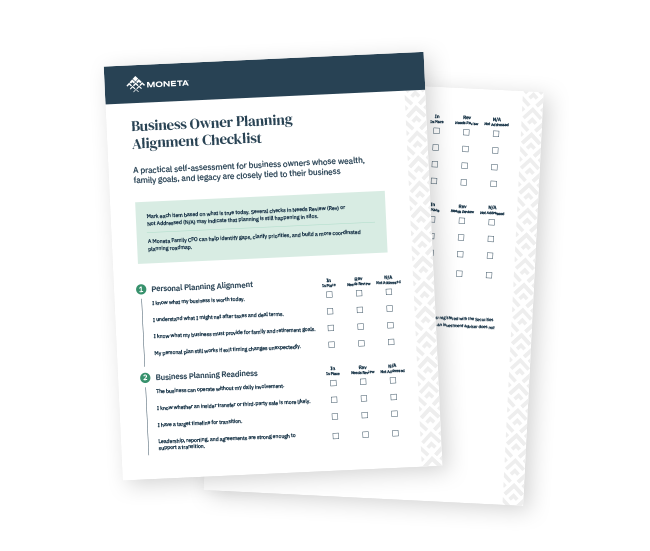
FREE PRINTABLE CHECKLIST
Business Owner Planning Alignment
Fill out the form to receive your planning checklist.
© 2026 Advisory services offered by Moneta Group Investment Advisors, LLC, (“MGIA”) an investment adviser registered with the Securities and Exchange Commission (“SEC”). MGIA is a wholly owned subsidiary of Moneta Group, LLC. Registration as an investment adviser does not imply a certain level of skill or training. The information contained herein is for informational purposes only, is not intended to be comprehensive or exclusive, and is based on materials deemed reliable, but the accuracy of which has not been verified. Trademarks and copyrights of materials referenced herein are the property of their respective owners. Index returns reflect total return, assuming reinvestment of dividends and interest. The returns do not reflect the effect of taxes and/or fees that an investor would incur. Examples contained herein are for illustrative purposes only based on generic assumptions. Given the dynamic nature of the subject matter and the environment in which this communication was written, the information contained herein is subject to change. This is not an offer to sell or buy securities, nor does it represent any specific recommendation. You should consult with an appropriately credentialed professional before making any financial, investment, tax or legal decision. An index is an unmanaged portfolio of specified securities and does not reflect any initial or ongoing expenses nor can it be invested in directly. Past performance is not indicative of future returns. All investments are subject to a risk of loss. Diversification and strategic asset allocation do not assure profit or protect against loss in declining markets. These materials do not take into consideration your personal circumstances, financial or otherwise.