

May Observations
Markets Climb on AI Momentum and Iran Optimism
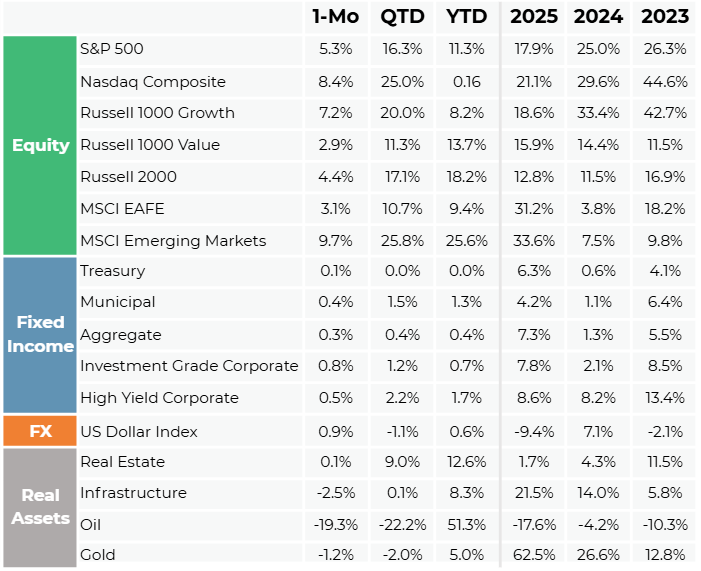
May was another constructive month for risk assets, and while the path was far from smooth, markets ultimately powered higher on ceasefire optimism and a resurgent AI trade. The S&P 500 gained 5.3% for the month, extending its winning streak to nine consecutive weeks, while the Nasdaq Composite outperformed at 8.4%, driven by blockbuster earnings from semiconductor and AI-infrastructure names. The broadening trade moderated relative to April, though emerging markets continued to perform well, returning 9.7% for the month, supported by the global risk-on tone and easing oil prices into month-end. U.S. small caps (Russell 2000) lagged large caps, posting a more modest 4.4% gain. Fixed income markets faced renewed pressure as war-driven energy costs stoked inflation fears and prompted a significant mid-month bond selloff as bond traders moved to fully price in a Fed rate hike by year-end, a notable shift in the policy narrative.
Inching Towards a Resolution
Geopolitical developments surrounding the U.S.-Iran conflict remained a consequential driver of market volatility in May. The closure of the Strait of Hormuz kept energy markets on edge throughout the month, with Brent crude trading above $115/barrel at its peak mid-month before retreating sharply toward month-end, finishing the month at $92/barrel as Iran ceasefire hopes gathered momentum.
Global Inflation and Central Bank Policy Divergence
Central banks were forced to navigate the increasingly difficult tradeoff between slowing growth and persistent price pressures. In the U.S., bond traders moved to fully price in a Federal Reserve rate hike by year-end, while European Central Bank officials signaled additional tightening may still be necessary despite weakening economic activity while Australia’s central bank also raised rates. The U.K. remained a notable outlier, with inflation cooling more rapidly than expected and prompting markets to scale back expectations for further Bank of England tightening.
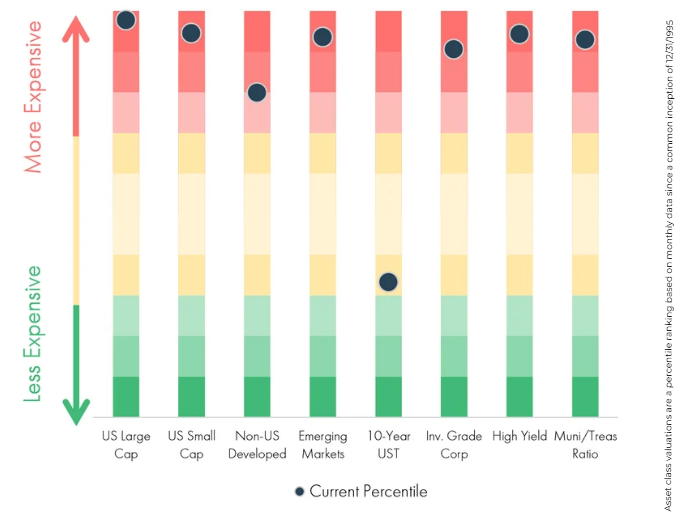
Asset Class Valuations – 5-31-2026
Asset Manager Commentary
Multi-Asset Portfolio Manager
Unlike previous capex booms that were largely one-time buildouts, this cycle is expected to require ongoing investment as the underlying technology quickly evolves. However, investors are increasingly focused on profitability rather than spending for spending’s sake, rewarding companies with the scale and market position to convert elevated capital expenditures into durable earnings growth.
Emerging Markets Manager
The emerging markets opportunity set is almost unrecognizable compared to even just a few years ago and could play at the heart of the next global growth cycle. Specific to AI Infrastructure, there is no AI without the Tech companies in Taiwan and South Korea. In the U.S., the question is, “Can AI make money?” In Asia, the question is, “How much?”
Short Duration Bond Manager
Despite the gradual lowering of rates by the Fed, money has continued to pour into money market funds. This manager commented that, when the market sees the Fed cutting rates, the market may be worried that the Fed is cutting because something bad may happen, hence the flight to safety in money market fund.
Chart of the Month
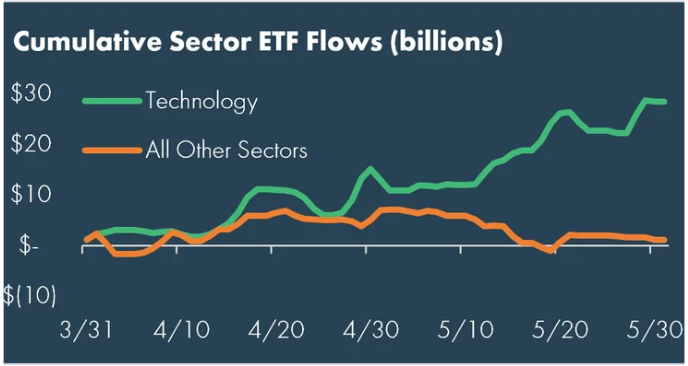
Flows remain a key source of support for the broader market, reflecting investors’ “buy-the-dip” mentality. Notably, recent flows have been relatively one-sided and concentrated, with technology ETFs attracting $28.5 billion in cumulative net inflows since the beginning of the quarter.
Disclosures
© 2026 Advisory services offered by Moneta Group Investment Advisors, LLC, (“MGIA”) an investment adviser registered with the Securities and Exchange Commission (“SEC”). MGIA is a wholly owned subsidiary of Moneta Group, LLC. Registration as an investment adviser does not imply a certain level of skill or training. The information contained herein is for informational purposes only, is not intended to be comprehensive or exclusive, and is based on materials deemed reliable, but the accuracy of which has not been verified.
Trademarks and copyrights of materials referenced herein are the property of their respective owners. Index returns reflect total return, assuming reinvestment of dividends and interest. The returns do not reflect the effect of taxes and/or fees that an investor would incur. Examples contained herein are for illustrative purposes only based on generic assumptions. Given the dynamic nature of the subject matter and the environment in which this communication was written, the information contained herein is subject to change. This is not an offer to sell or buy securities, nor does it represent any specific recommendation. You should consult with an appropriately credentialed professional before making any financial, investment, tax or legal decision. An index is an unmanaged portfolio of specified securities and does not reflect any initial or ongoing expenses nor can it be invested in directly. Past performance is not indicative of future returns. All investments are subject to a risk of loss. Diversification and strategic asset allocation do not assure profit or protect against loss in declining markets. These materials do not take into consideration your personal circumstances, financial or otherwise.
Sources
Morningstar Direct, Bloomberg as of 5/31/2026
Manager comments come from discussions with various asset managers and are broad commentary on sectors and not be considered recommendations by any asset manager. These comments do not necessarily reflect strategy allocations or the view or opinion of MGIA or Moneta Group .
Definitions
The S&P 500 Index is a free-float capitalization-weighted index of the prices of approximately 500 large-cap common stocks actively traded in the United States.
The NASDAQ Composite Index is a market capitalization weighted index with more than 3000 common equities listed on the NASDAQ Stock Market.
The NASDAQ 100 Index is a modified capitalization-weighted index of the 100 largest and most active non-financial domestic and international issues listed on the NASDAQ..
The Russell 1000® Index is an index of 1000 issues representative of the U.S. large capitalization securities market.
The Russell 1000® Growth Index measures the performance of the large-cap growth segment of the U.S. equity universe. It includes those Russell 1000 companies with higher price-to-book ratios and higher forecasted growth values.
The Russell 1000® Value Index measures the performance of those Russell 1000 Index securities with lower price-to-book ratios and lower forecasted growth values, representative of U.S. Securities exhibiting value characteristics.
The Russell 2000® Index is an index of 2000 issues representative of the U.S. small capitalization securities market.
The MSCI EAFE Index is a free float-adjusted market capitalization index designed to measure the equity market performance of developed markets, excluding the U.S. and Canada.
The MSCI Emerging Markets Index is a float-adjusted market capitalization index that consists of indices in 21 emerging economies.
Bloomberg U.S. Treasury Bond Index includes public obligations of the US Treasury, i.e. US government bonds. Certain Treasury bills are excluded by a maturity constraint. In addition, certain special issues, such as state and local government series bonds (SLGs), as well as U.S. Treasury TIPS, are excluded.
The Bloomberg U.S. Municipal Index covers the USD-denominated long-term tax exempt bond market. It includes general obligation and revenue bonds, which both can be pre-refunded years later and get reclassified as such.
The Bloomberg U.S. Aggregate Bond Index is an index, with income reinvested, generally representative of intermediate-term government bonds, investment grade corporate debt securities and mortgage-backed securities.
The Bloomberg US Corporate Bond Index measures the investment grade, fixed-rate, taxable corporate bond market. It includes USD-denominated securities publicly issued by US and non-US industrial, utility and financial issuers.
The Bloomberg US Corporate High Yield Bond Index measures the USD-denominated, high yield, fixed-rate corporate bond market. Securities are classified as high yield if the middle rating of Moody’s, Fitch and S&P is Ba1/BB+/BB+ or below. Bonds from issuers with an emerging markets country of risk, based on the indices’ EM country definition, are excluded.
The US Dollar Index measures the US dollar against six global currencies: the euro, Swiss franc, Japanese yen, Canadian dollar, British pound, and Swedish krona.
The FTSE Nareit All Equity REITs Index is a free-float adjusted, market capitalization-weighted index of U.S. equity REITs. Constituents of the index include all tax-qualified REITs with more than 50 percent of total assets in qualifying real estate assets other than mortgages secured by real property.
The S&P Global Listed Infrastructure Index measures the performance of global companies that are engaged in infrastructure and related operations. It provides liquid and tradable exposure to 75 companies from around the world that represent the listed infrastructure universe. To create diversified exposure, the index includes three distinct infrastructure clusters: utilities, transportation and energy.
Brent Crude is the most traded of all of the oil benchmarks, and is defined as crude mostly drilled from the North Sea oilfields: Brent, Forties, Oseberg and Ekofisk (collectively known as BFOE).
The Dow Jones Commodity Index Gold is designed to track the gold market through futures contracts.
The ICE BofA Option-Adjusted Spreads (OASs) are the calculated spreads between a computed OAS index of all bonds in a given rating category and a spot Treasury curve. An OAS index is constructed using each constituent bond’s OAS, weighted by market capitalization. The Corporate Master OAS uses an index of bonds that are considered investment grade (those rated BBB or better). When the last calendar day of the month takes place on the weekend, weekend observations will occur as a result of month ending accrued interest adjustments.
The ICE BofA Option-Adjusted Spreads (OASs) are the calculated spreads between a computed OAS index of all bonds in a given rating category and a spot Treasury curve. An OAS index is constructed using each constituent bond’s OAS, weighted by market capitalization. The ICE BofA High Yield Master II OAS uses an index of bonds that are below investment grade (those rated BB or below).
Asset class valuations are a percentile ranking based on monthly data going back to common inception of 12/31/1995. The US Large Cap percentile is the average percentile ranking of the trailing P/E, P/B, P/S, and P/C ratio of the S&P 500 Index. The US Small Cap percentile is the average percentile ranking of the trailing P/E, P/B, P/S, and P/C ratio of the Russell 2000 Index. The International Developed percentile is the average percentile ranking of the trailing P/E, P/B, P/S, and P/C ratio of the MSCI EAFE Index. The Emerging Market percentile is the average percentile ranking of the trailing P/E, P/B, P/S, and P/C ratio of the MSCI Emerging Markets Index. The 10-Year US Treasury percentile is the percentile ranking of the 10-Year US Treasury yield. The Investment Grade percentile is the percentile ranking of the ICE BofA US Corporate option adjusted spread. The High Yield Corporate percentile is the percentile ranking of the ICE BofA US High Yield corporate option adjusted spread. The Municipal/Treasury percentile is the percentile ranking of the Bloomberg Municipal Index yield divided by the 10-Year US Treasury Yield.
Related Topics to Explore

Third Quarter 2026 Investment Update
October 20, 2026
Executive Summary The third quarter of 2026 reinforced a market environment in which economic resilience and corporate e…


Monthly Recap – August 2026
September 10, 2026
August Observations Markets Recover from a Summer Lull After two weaker months, US equity markets were in a risk-on mood…

The Bond Market Speaks: Unraveling the Recent Increase in Interest Rates
September 2, 2026
There is no excerpt because this is a protected post.